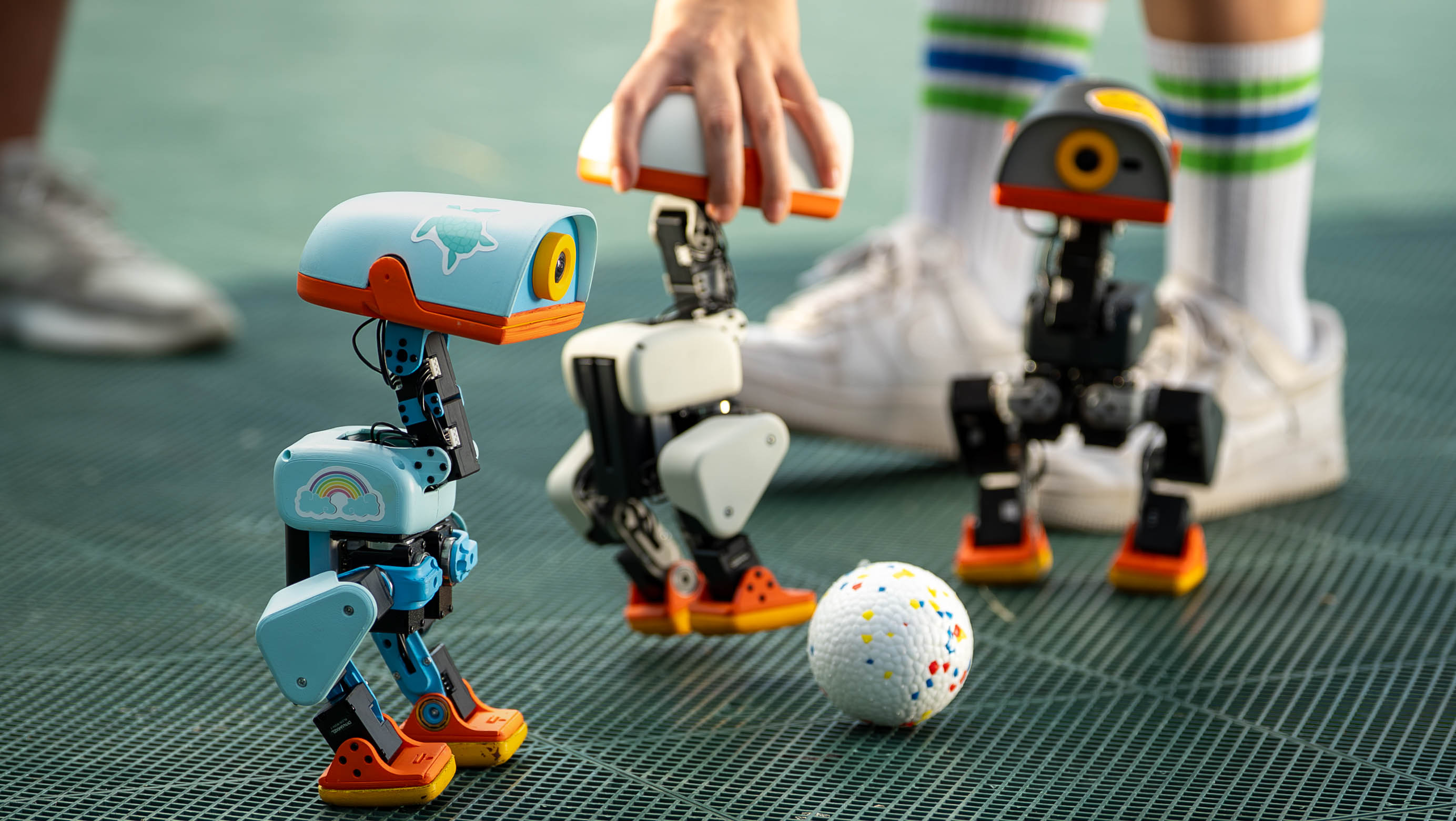
“Sit.” The little ducks sit. At nap time, they lie down on the stage. Imagine the most memorable part of an AI presentation being four ducks rather than semiconductor numbers. The robots alongside Jensen Huang are called Microduck. They look like pets, but underneath they are closer to tiny laboratories for teaching AI to use a body.
The event was the GTC Berlin keynote in Germany on October 21, 2026; sources were checked on October 26. This is not a verified claim that Huang personally owns the robots as pets. NVIDIA event account · NDTV report dated October 23
Key points
- The ducks at GTC Berlin on October 21 were Microducks from Hugging Face and Pollen Robotics.
- The key is not only cute movement but transferring learned behaviours from simulation to a physical body.
- A stage demo does not establish household skills or universal autonomy; announced price and delivery targets differ from actual purchase conditions.
1. Why bring a 25 cm duck to an AI event?
The maker is France’s Pollen Robotics, Hugging Face’s robotics team. Its introduction describes a robot about 25 cm tall and under 800 g, with 15 motors, a camera and depth sensing. The articulated beak can grasp objects; behaviours include walking, sitting and recovering from some common fallen positions. Maker introduction
The interesting shift is that AI’s homework expands from choosing the next word to choosing how a body should move. A floor does not forgive a typo: lose balance and the body falls rather than merely needing an edited answer. That difference is an approachable entry to physical AI.
From virtual practice to a duck’s footsteps
An editorial four-step reconstruction of NVIDIA’s GTC demonstration explanation.
- 01Virtual practice groundBuild the robot simulation and course in Isaac Sim.
- 02Cloud trainingSend training jobs to learn a behaviour policy.
- 03Evaluate the resultBring the learned policy to RTX Spark for evaluation.
- 04Deploy to hardwareApply the evaluated policy to the physical robot.
2. A duck practises in a virtual world first
NVIDIA describes a training video in which an agent creates a course and simulates the robot in Isaac Sim, then sends training jobs to the cloud. The learned behaviour policy returns to RTX Spark for evaluation before deployment to the physical robot. Official demonstration account · Watch the demonstration
Think of refining movement in a game-like practice ground before repeatedly toppling the real duck. That is an explanatory analogy. Reinforcement learning improves behaviour through attempts and outcomes; the maker describes released tools for simulation, reinforcement learning and deployment to hardware. Learning virtually does not establish success on every real floor. Software explanation
| What catches the eye | Technology to look behind it | What it does not establish |
|---|---|---|
| Waddling | Balance and motion control | Mobility on every terrain |
| Sitting and standing again | Learned behaviours and recovery | Recovery from every fall |
| Moving on a spoken cue | Action coordination in a stage demo | A universal assistant understanding all speech |
| Released software | Control, training and deployment tools | Publication of every hardware design |
3. Between an obedient duck and an all-purpose butler
NDTV reported that three robots lay down first while the fourth took a few more steps before joining them. It is amusing, but a delay alone is no evidence of feelings or stubbornness. Nor does a cued demonstration establish general language understanding or household-task ability. Demonstration report
The maker emphasises a platform where developers and learners can create and modify behaviours. Crucially, open source refers to the software. The press kit explicitly says the mechanical and electronic design files are not included, so the robot should not be described as open-source hardware. Cute looks should not blur technical boundaries. Scope of openness
4. Can you buy one? Three checks before the price tag
The maker’s August 27 announcement offered pre-orders at an introductory $399 before tax and shipping, targeting initial deliveries before Christmas 2026. A target is different from completed delivery; these sources do not establish shipping to Korea or a final Korean-won price. Price and delivery target
If interested, check actual shipping regions and dates, behaviours available immediately versus those requiring development, and the usage and data-processing conditions for sensors such as cameras and microphones. Classroom walking experiments or cooperation between several robots are plausible directions to look forward to. They are distinct from a promise to do your housework tomorrow.
The attraction is not AI suddenly becoming human. It is a learned result stepping out of the screen on tiny feet. After the adorable nap, ask: Which behaviour was learned, where was it learned, and how reliably can it repeat in reality?